Pay when the outcome is verified.
Not for hours logged. Not for tokens spent. Every Rezoomex engagement is coded as an smart contract, and payment follows a verified result.
- Smart contract formedOutcome, fee, timeframe
- Agent builtMeasured against the evals
- Evals passOutcome proven
- Payment releasedAutomatically
Every common contract pays for something other than the result.
| Time and materials | Fixed bid | Outcome contract | |
|---|---|---|---|
| You pay for | Hours | Delivered scope | A verified result |
| If the scope was the wrong problem | You pay more | You pay anyway | It's caught in Discovery, before the build |
| Proof at the end | Timesheets | A sign-off on features | Evidence the metric moved |
Four steps from commitment to payment.
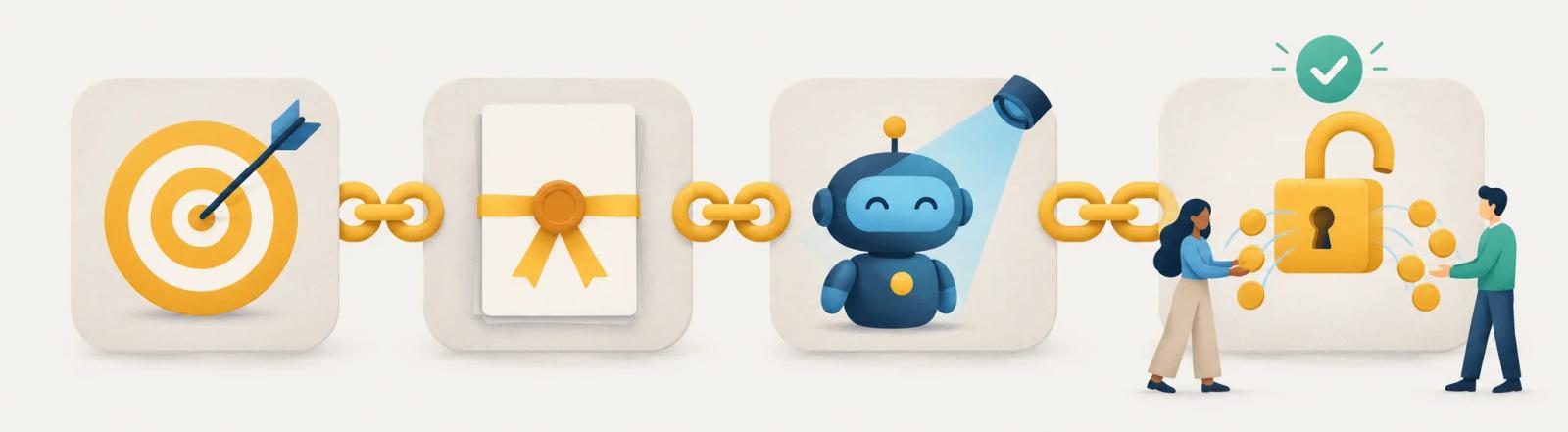
- Step 1
Agree the outcome
Discovery defines the business pain, priority or challenge, and the metric that proves it's fixed, with a baseline.
- Step 2
Agree the proof
Before any build, both sides agree how the result will be verified. The terms are recorded in a blockchain-based smart contract.
- Step 3
Build and verify
The AI Product Builder builds the agent and the harness that observes its output and checks it against the playbook and rubric.
- Step 4
Pay on verified outcome
When the evals show the outcome was reached, the smart contract executes and payment is released.
A contract both sides can hold each other to.
Everything that decides whether you pay is written down before any build starts, so there is nothing to argue about at the end.
- The outcome, in plain words
- The metric and its starting baseline
- How the result will be verified, and by whom
- The timeline
- The price, and what triggers payment
Fair to both sides.
Pay for results you can show your stakeholders
And stop funding work that misses the point.
Build a record of verified results
Learn to work this way on your own projects today, instead of logging hours.
Who decides whether the result is verified?
Both sides agree the outcome and how it will be verified before the build starts. The playbook acts as the eval set, so there is no arbitration: the evals decide.
Can every project be an outcome contract?
Most can, once Discovery has defined a measurable outcome. Work that can't be measured yet starts with Discovery itself.
Is this a legal contract?
No. It's a programmatic, blockchain-based smart contract. It records the agreed outcome, fee and any timeframe, and executes automatically when the evals prove the outcome. If the condition isn't met, the contract is void.